Problem Set
NBPhO 2026
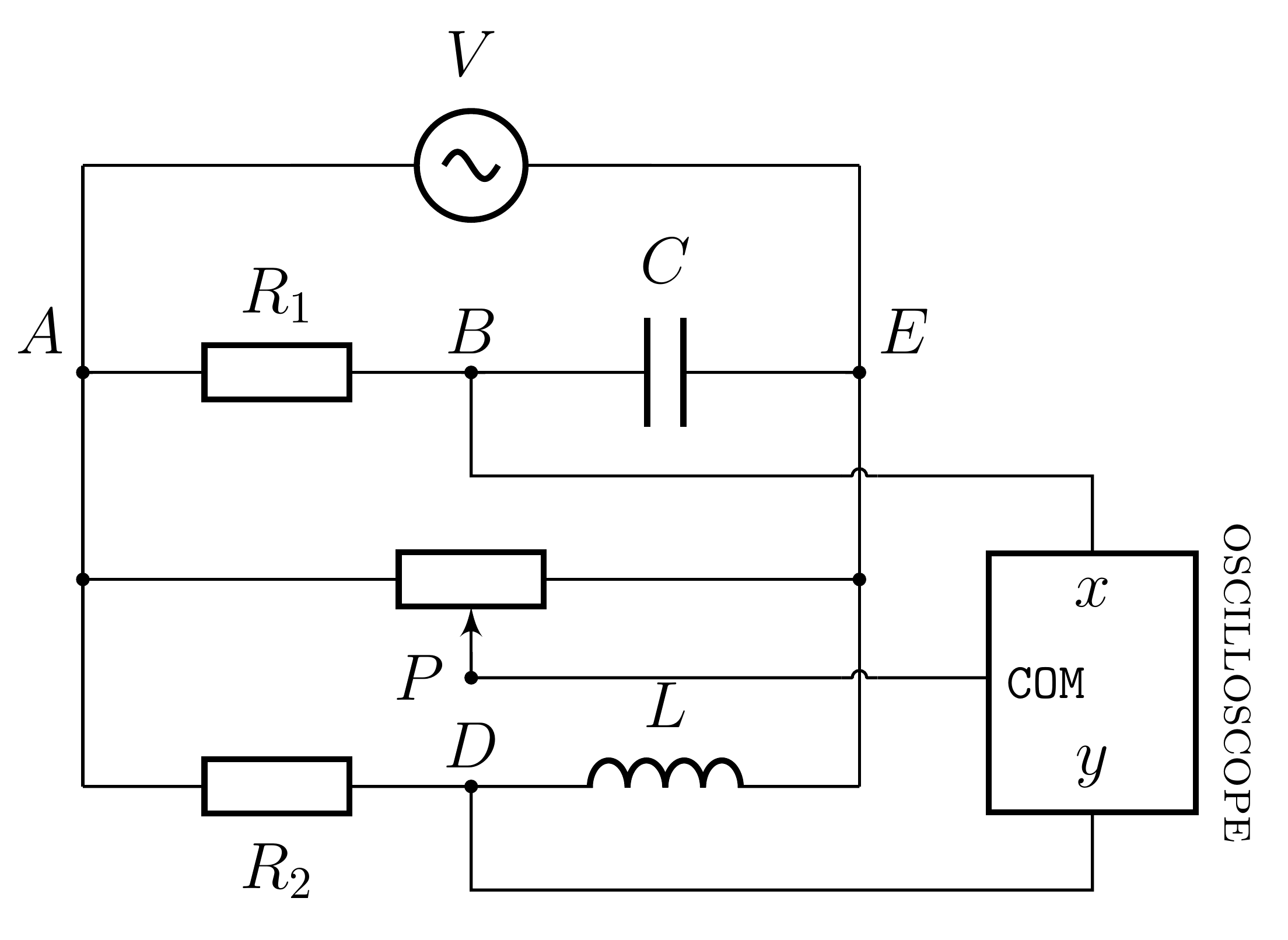
2. Lissajous Bridge 6 pts
Find the on-screen amplitude of the -channel signal at the slider position that collapses the oscilloscope Lissajous trace into a line segment.
A circuit has four nodes , , , . An AC source of amplitude is applied between and . A resistor connects to and a capacitor connects to ; a resistor connects to and an inductor connects to . A potentiometer with a sliding contact is connected between and . The voltage between and feeds the -input of an oscilloscope, and the voltage between and feeds the -input; both input channels have the same gain. The oscilloscope plots the voltage from the -input and the voltage from the -input in the –-plane. The position of the sliding contact is adjusted until the figure on the screen degenerates into a line segment. It appears that in that case, the line segment makes an angle with the -axis, and the sliding contact divides the potentiometer’s length in the ratio from left to right in the figure. Find the amplitude of the voltage between and .