Electricity · AC circuits, Phasors, AC bridge, Lissajous figures
Find the on-screen amplitude of the x-channel signal at the slider position that collapses the oscilloscope Lissajous trace into a line segment.
Solution by Jaan Kalda.
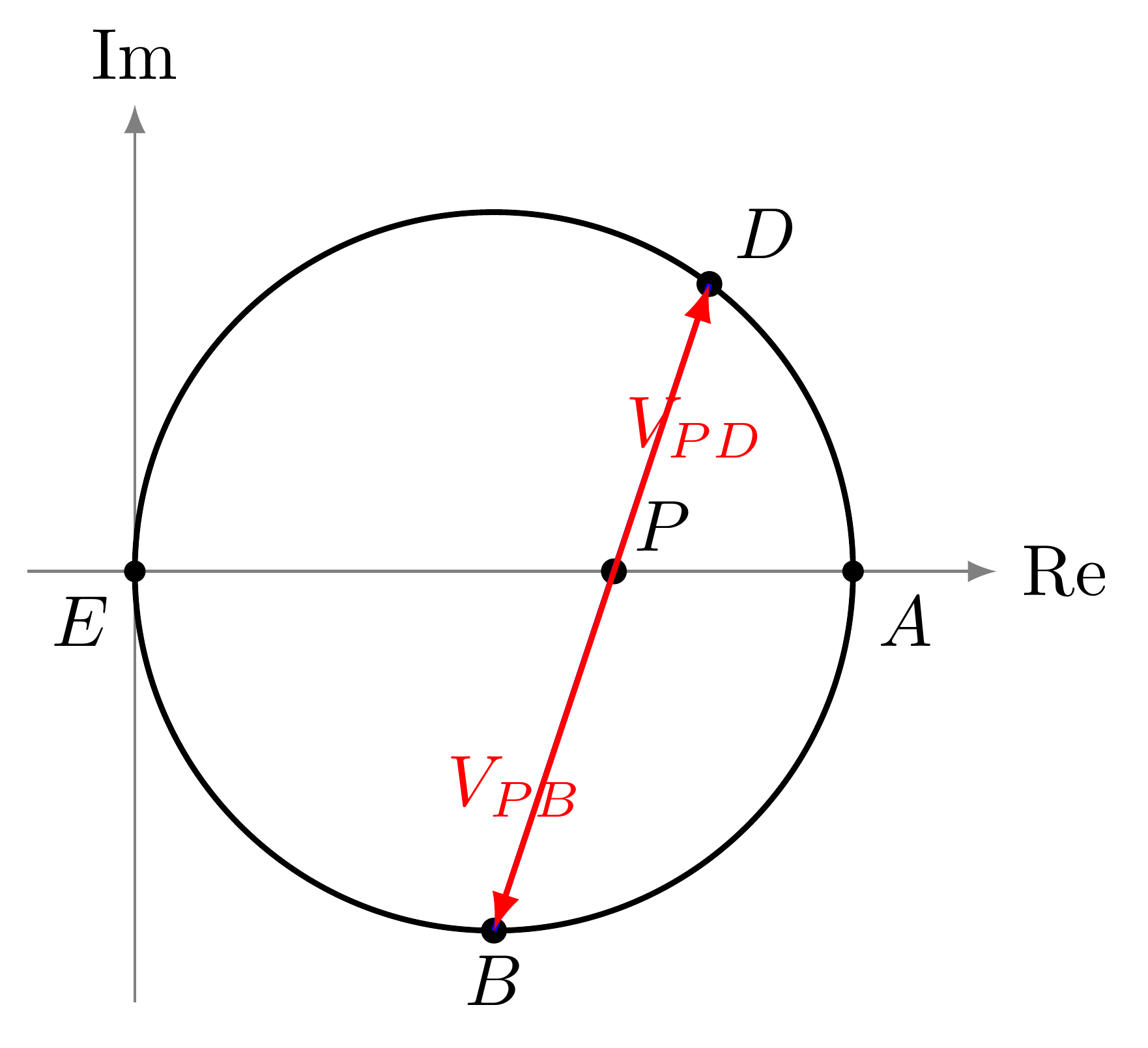
Set VE=0 and VA=V (phasor). Consider the RC branch: since R1 and C carry the same current, their voltages are in the impedance ratio ZC/ZR1=1/(iωR1C)=−i/ωR1C. The factor −i is a 90∘clockwise rotation in the phasor plane, so VBE is VAB rotated 90∘ clockwise — in particular, VAB⊥VBE, and VB lies in the lower half-plane (ImVB<0).
For the RL branch, ZL/ZR2=iωL/R2: the factor i is a 90∘counterclockwise rotation, so VDE is VAD rotated 90∘ counterclockwise, giving VAD⊥VDE and VD in the upper half-plane (ImVD>0).
By Thales’ theorem applied to each branch, both VB and VD lie on the circle of diameter AE (centre V/2, radius V/2), on opposite semicircles.
The oscilloscope displays VPB on x and VPD on y; the Lissajous figure degenerates to a line when these phasors are parallel or anti-parallel — equivalently, when P, B, D are collinear in the phasor plane. Since VB and VD are on opposite sides of the real axis, and VP is real (a fraction of V), VP lies between them on the line, so VPB and VPD are anti-parallel. Hence the displayed line has negative slope and
∣tanα∣=∣VPB∣∣VPD∣.
The potentiometer is split 1:2 from left to right; depending on the orientation this gives VP=V/3 or VP=2V/3. The power of point P with respect to the Thales circle,
pow(P)=VP(VP−V),
takes the value −2V2/9 in both cases (by symmetry of the quadratic about VP=V/2). Since P is inside the circle and the line BPD cuts it at two points,
∣PB∣⋅∣PD∣=∣pow(P)∣=92V2.
Combining with ∣tanα∣=∣VPD∣/∣VPB∣:
∣VPB∣2∣tanα∣=92V2,∣VPB∣=3V∣tanα∣2.
Grading (6 points total)
Showing that VAB⊥VBE: 0.5 pts
Showing that VAD⊥VDE: 0.5 pts
Correctly identifying that VB lies in the lower half-plane (ImVB<0) (ImVB>0 if VA=0): 0.3 pts
Correctly identifying that VD lies in the upper half-plane (ImVD>0) (ImVD<0 if VA=0): 0.3 pts
Identifying that VB lies on a circle with AE as a chord: 0.3 pts
Identifying that VD lies on a circle with AE as a chord: 0.3 pts
Identifying AE as the diameter of the (common) circle: 0.3 pts
Recognising that Lissajous degeneracy requires B, P, D collinear in the phasor plane: 1.5 pts
Applying power of a point at VP to get ∣PB∣⋅∣PD∣=2V2/9: 1.0 pts
Correctly relating ∣tanα∣ to the voltage amplitude ratio ∣VPD∣/∣VPB∣ (only if phasors considered)
Combining with the power-of-a-point result to obtain the final answer: 0.5 pts
Since the condition the line segment makes an angle α with the x-axis could be understood in different ways, we did not deduct marks for failing to realize that the slope is negative or using tanα without absolute value.
Alternative solution (pure algebraic/impedance method, for students who do not spot the Thales circle). Ground node E and write VA=V. The voltage dividers at B and D give
VB=1+iωR1CV,VD=1−iR2/(ωL)V,
and the resistive slider gives VP=2V/3 (or V/3; the answer is insensitive to this choice). Introduce dimensionless parameters u=ωR1C and w=R2/(ωL), so that
VB=1+u2V(1−iu),VD=1+w2V(1+iw).
Taking VP=2V/3, write VPB/V=XB+iYB and VPD/V=XD+iYD:
The Lissajous curve degenerates to a line iff VPB/VPD is real, i.e., XBYD−YBXD=0. Substituting and simplifying yields
(u+w)(2uw−1)=0,
so (since u,w>0) the bridge condition is uw=1/2, i.e., R1R2C=L/2. The slope of the displayed line equals the ratio of the phasors (both now real), conveniently computed from imaginary parts:
tanα=YBYD=−u(1+w2)w(1+u2).
Substituting w=1/(2u) gives
tanα=−1+4u22(1+u2),so1+u21+4u2=∣tanα∣2.(†)
The amplitude between B and P follows from XB2+YB2:
Expressing VPB/V and VPD/V in the form X+iY with explicit real and imaginary parts: 0.5 pts
Recognising that the Lissajous curve degenerates to a line iff VPB/VPD is real (i.e., XBYD−YBXD=0, or equivalent condition): 0.7 pts
Correctly deriving the bridge condition R1R2C=L/2 (equivalently uw=1/2): 0.5 pts
Expressing tanα in terms of u and w (or equivalent parameters): 0.5 pts
Substituting the bridge condition to write tanα as a function of u alone: 0.5 pts
Correctly computing ∣VPB∣2 in terms of u (before factoring): 0.7 pts
Recognising the factoring 4u4+5u2+1=(4u2+1)(1+u2) that simplifies ∣VPB∣2: 0.8 pts
Eliminating u using the tanα expression: 0.3 pts
Obtaining the final answer ∣VPB∣=(V/3)2/∣tanα∣: 0.5 pts
Students who reach the correct final form via either route receive full credit. Algebraic errors may lose the corresponding stage points but could retain partial credit if the overall structure is right.