Problem Set
NBPhO 2026
8. Jet Sound 8 pts
Decode a supersonic flyby spectrogram to extract the Mach number and closest-approach distance from the Doppler asymptotes and the sonic-boom delay.
A fighter jet flies past a ground observer along a straight horizontal line at constant supersonic velocity, passing at closest-approach distance . The jet’s Mach number is , where is the speed of the jet and is the speed of sound. The air is at rest. The observer records the sound as a spectrogram (intensity colour-coded as a function of frequency and time; black means silence), shown below.
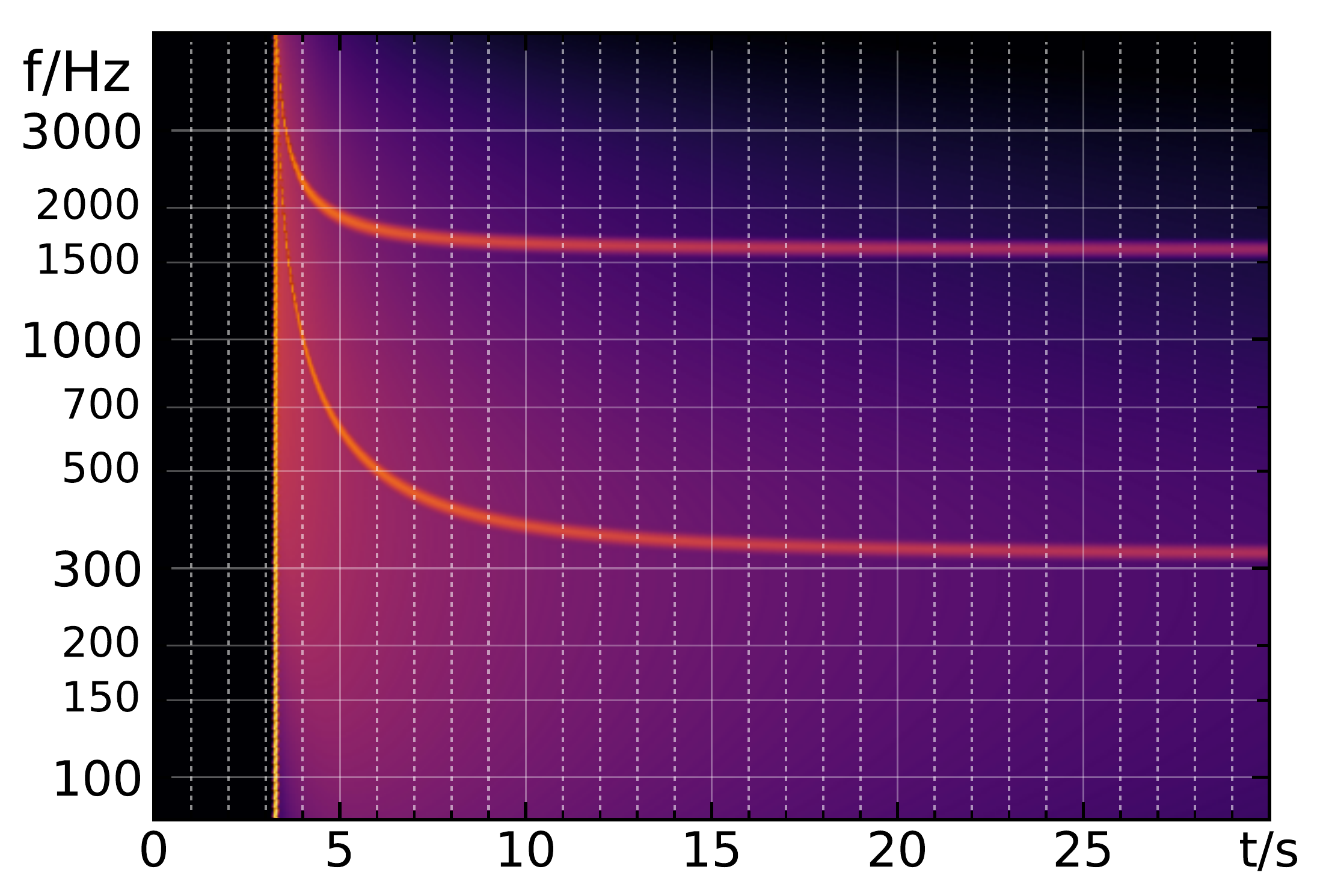
i) (2 points) Explain, qualitatively, the features seen in the spectrogram.
ii) (3 points) From the spectrogram, find the Mach number .
iii) (3 points) Find the closest-approach distance given that .