Problem Set
NBPhO 2026
9. CO₂ Fire Extinguisher 8 pts
Use a – diagram of CO₂ to find the dry-ice fraction in the exhaust of a fire extinguisher for two cylinder orientations, then derive the condition under which adiabatic expansion of saturated vapour spontaneously condenses.
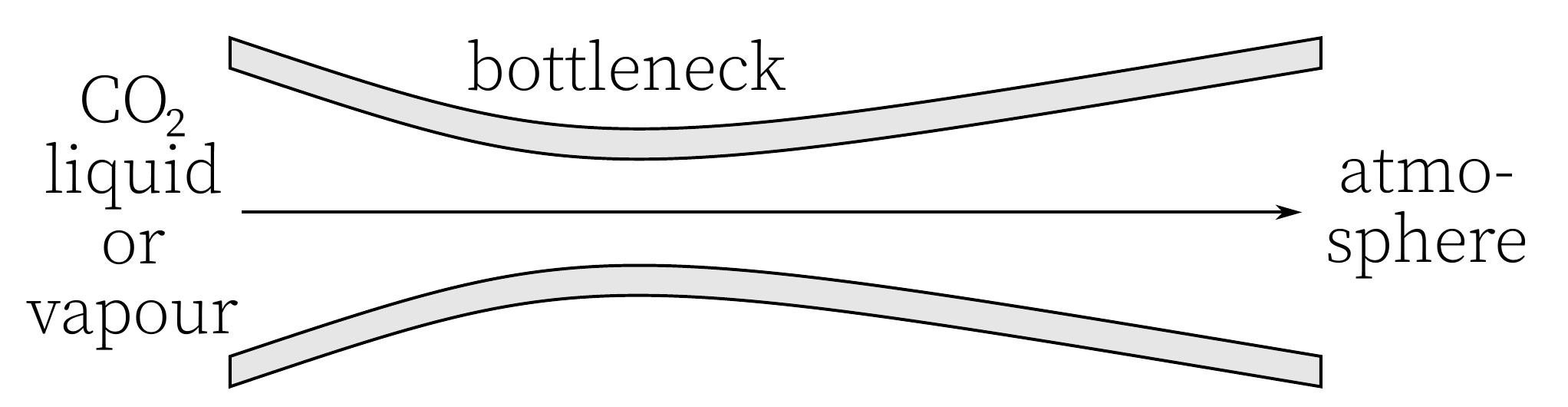
A fire extinguisher contains liquid CO₂ in equilibrium with its saturated vapour at room temperature . Consider two scenarios: (a) the container is held upside-down so that the liquid phase flows to the nozzle; (b) it is held upright so that the saturated vapour flows to the nozzle. The nozzle has the shape of a converging–diverging channel (see figure), and the flow through it can be modelled as reversible and adiabatic. Atmospheric pressure is ; the CO₂ triple point is at .
The temperature–entropy diagram of CO₂ with isobars is provided below.
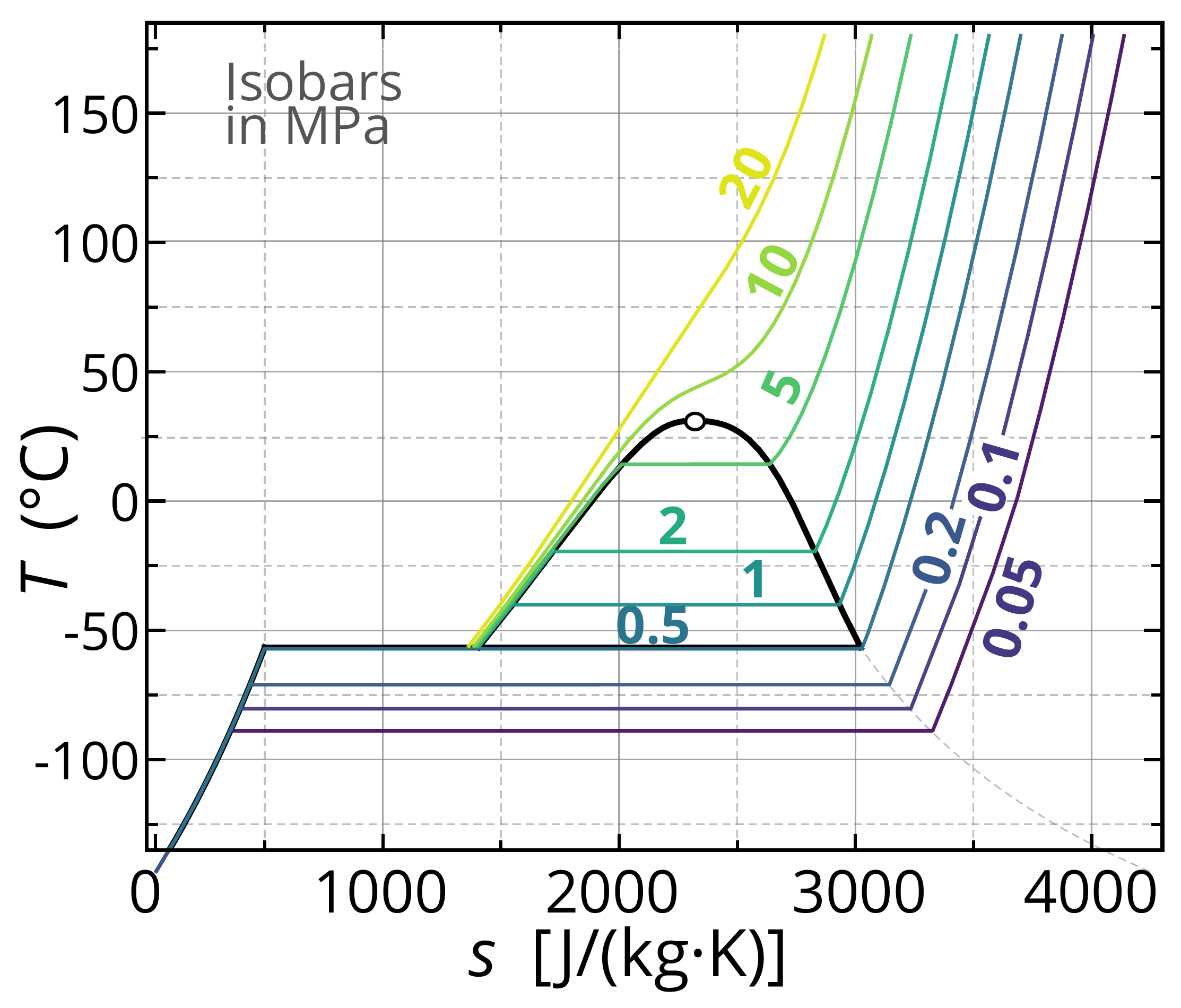
i) (1.5 points) Identify the phase or phases present and their temperature in the stream emerging from the nozzle.
ii) (3.5 points) Find the mass fraction of solid CO₂ in the stream for both scenarios.
iii) (3 points) Now consider an arbitrary pure substance in equilibrium with its saturated vapour at temperature , and suppose that only the vapour (not the liquid) escapes through a nozzle, undergoing reversible adiabatic expansion. Under what condition on the vaporisation latent heat (per unit mass), the isobaric specific heat of the vapour , and the temperature does a fraction of the escaping vapour condense into droplets, even for a vanishingly small pressure drop? Does condensation occur for water vapour at (, )?