Problem Set
NBPhO 2026
1. Moving Lens 6 pts
Reconstruct the unseen circular path of a moving thin lens, and the direction of its plane, from the closed image curves it traces of two fixed object points.
Part i) (2 points)
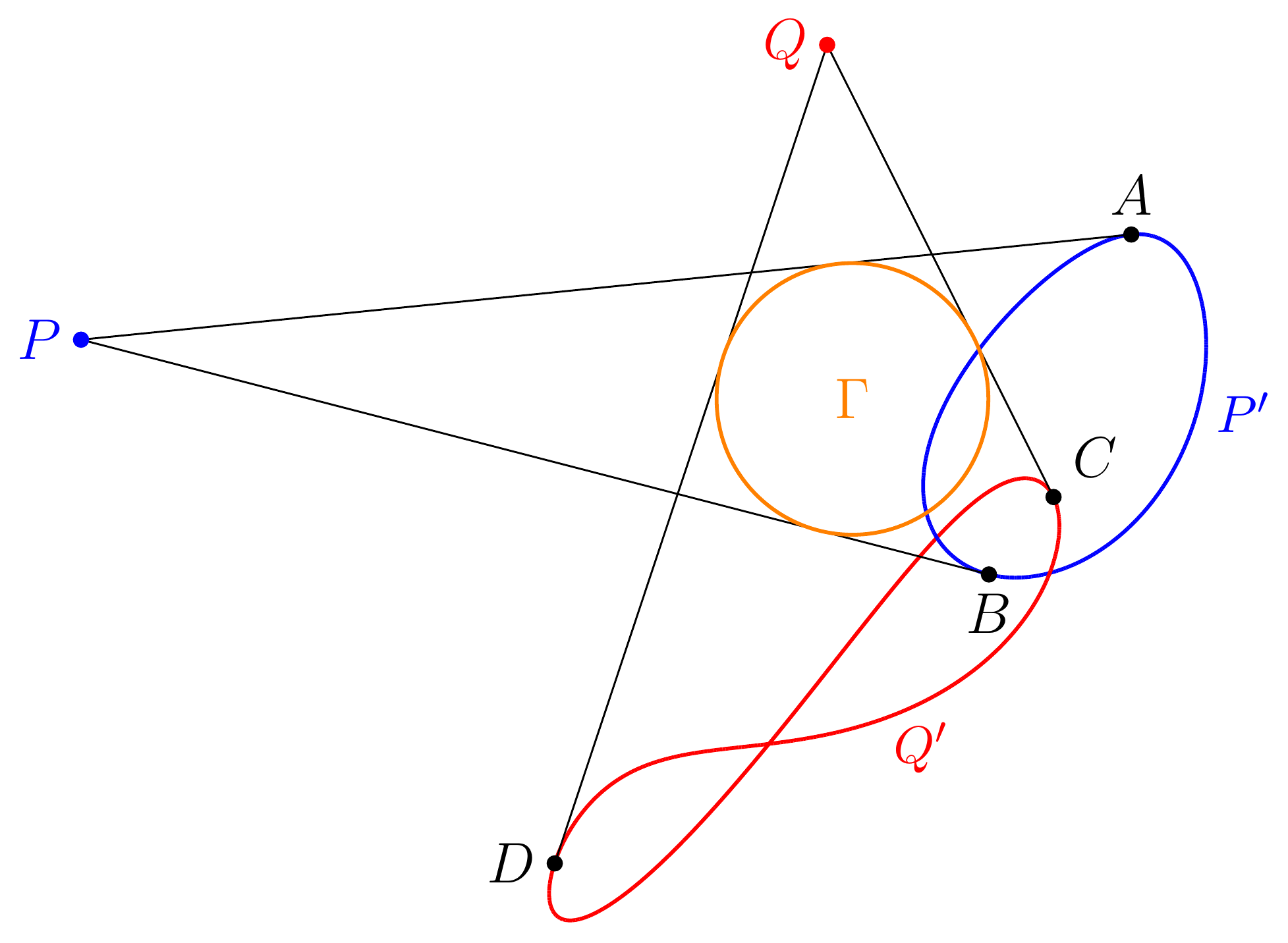
Let denote the circle traced by the lens centre. A light ray from that passes through the lens centre is undeflected, so it continues straight through to the image of at that moment. As moves around , the undeflected ray through and sweeps out a family of lines through , and its intersection with the image curve gives the current image. The extreme angular positions of this sweep correspond to being at the tangent points of as seen from — that is, the lines from that are tangent to . At these extreme instants the corresponding image point on is where the line from is tangent to the curve .
Hence: from , draw the two lines tangent to curve — call them , with point and on curve . They are tangent to . Repeat from , drawing two lines tangent to — call them with and on curve . These are also tangent to . Four tangent lines determine the circle : for instance, the centre of lies at the intersection of the angle bisectors of any two pairs of these tangents (since each bisector is the locus of points equidistant from two lines). Project this centre perpendicularly onto any tangent to get the radius, and draw .
Grading
- Recognising that a ray from through the lens centre is undeflected: 0.2 pts
- Recognising that the tangents from to curve are tangent to : 0.8 pts
- Correct detailed construction idea of (from at least three of) the four tangent lines: 0.5 pts
- Correctly performed construction (i.e. constructed circle on paper is close to the actual circle): 0.5 pts
- Only given if the construction corresponds to a correct idea
- It is important that the circle intersects and not
Part ii) (4 points)
Fix any point on . It is enough to find one other point on the lens to draw the lens plane at this position. For this, we aim to identify the images of and for this chosen point for the centre of the lens.
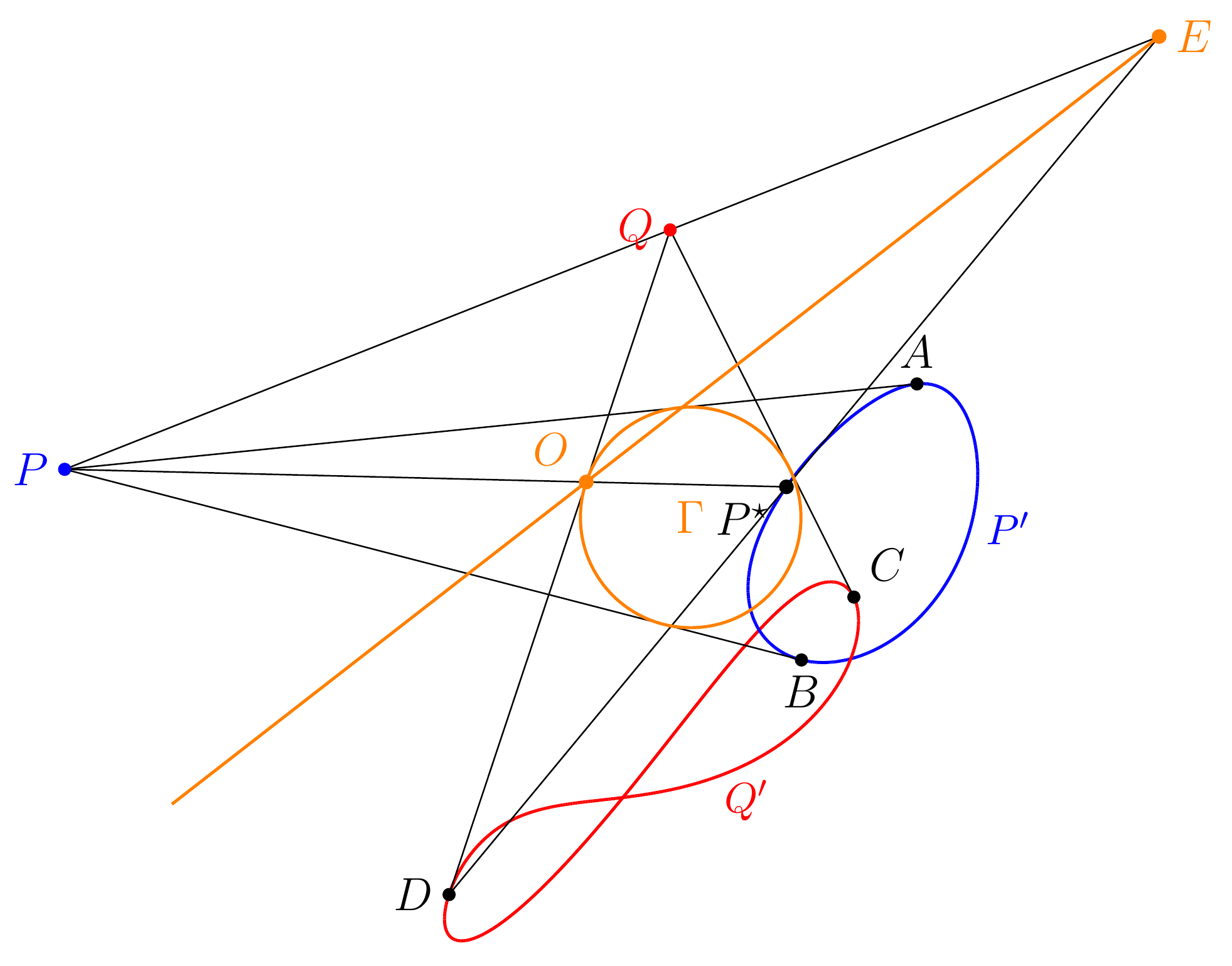
Draw the line through and ; it extends to intersect curve possibly at two points. The intersection corresponding to the location of the lens needs to be determined. Using continuity and the reality of images: as moves continuously around , the image moves continuously on , and the tangent-correspondence from (i) matches regions of with regions of . (Moreover, near an intersection of with , the corresponding must be the far intersection of line with — the near intersection would place the object within the focal region, making the image virtual.) This resolves the ambiguity and identifies as the current image of . For , the above identification procedure doesn’t work as it does not intersect and thus intersection with the focal region (a priori we do not know the focal length) is not guaranteed. Therefore, it is convenient to pick point to be such that is tangent to in which case there is only one valid point ( or ). In the figure, is chosen such that is , then is the closer intersection of with .
Now we have: object imaged to , object imaged to , through a lens with centre at . With two objects and their real images under a converging lens, the lens can be reconstructed. Suppose a light ray starts from toward . Then, as and are the images of and (and the lens is ideal), the ray must refract from the lens to form the line . Therefore the lines and intersect at the lens plane plane, identifying another point of the lens plane . Thus is the lens plane at the moment of time where the centre of the lens is at and is thus parallel to the lens plane at all moments in time.
Grading
- Idea: selecting a specific intending to find its image pair to locate the lens plane: 0.5 pts
- Correct argument that the image points and object points are enough to find the lens plane (eg. analysing as a ray that refracts to a line through the image points): 0.5 pts
- Justification for the correspondence between regions of and an image curve ( or ): 1 pts
- Uses continuity of motion (to split image curve into regions corresponding to regions in ): 0.5 pts
- Given only if it is explicitly mentioned or implicitly used in correct reasoning to relate a point on to its unique real image in a non-trivial case
- Uses correct reasoning to relate a point on to its unique real image: 0.5 pts
- Uses continuity of motion (to split image curve into regions corresponding to regions in ): 0.5 pts
- Identifying the correct image point on (or , non-trivial case): 1 pts
- Correct point with no or weak justification: 0.5 pts
- Choosing point such that the image on (or ) is at the tangent (alternatively, a correct argument for finding the correct point on the other image curve (or )): 0.5 pts
- This point is given for finding the point on the other curve (in relation to items 3 and 4) with justification. Alternatively if student only has identified one point on one curve with just tangency, give 0.5 points for this and nothing for items 3 and 4.
- Correctly performed construction (consistent with detailed steps to a correct construction): 0.5 pts
NB! Due to in accurately drawn diagrams, it can seem like that there is a lens position where will image to the intersection of and to one of its tangents . In this case identifying points and will in total give 2 points (instead of 1.5 points) which replaces items 3–5 in the above scheme. In addition points will be given for an inaccurately drawn diagram. I.e. in this case maximum of points is 3.
Grading (replaces items 3–5)
- Finding with two trivial points: 2 pts
- No points for correctly performed construction (due to inaccuracy)
Solution 2. This problem can also be solved using the lens formula. Namely, take the tangent lines (or if any two line for which you know how to identify the points). Take the angle between these lines and the angles and at which the optical axis (perpendicular to the lens) intersects these. From basic geometry (exact equation depends on the definitions). Now the lens positions and relevant, will split the lines in lengths and for one line and and for one line. Then the lens equation states (whether or not it is cosine or sine depends on the definitions). Now we have two equations and two unknowns. Thus (or ) can be solved and thus a parallel line drawn with a protractor.
Grading
- Image points identified correctly (either trivial or non-trivial justification): 0.5 pts
- Lens formula written with respect to measured lengths (projected correctly): 0.5 pts
- Angle/direction solved correctly (all or nothing): 2.5 pts
- Correctly performed constructions (angles match) (only given for correctly calculated angle): 0.5 pts