Problem Set
NBPhO 2025
5. Throwing 6 pts
Minimum-speed projectile to intercept an accelerating drone, and graphical determination of speeds in a stone–ball intercept problem.
Part i (2 points)
In the drone’s reference frame, the effective gravitational field is , which has a magnitude of pointing at a 45° angle. The initial kinetic energy of the ball is , and the potential energy change is , where is the displacement along the direction of the effective field. From the energy conservation law we obtain , hence
Solution 2 by Anne-Sofie Mårtensson and Adam Warnerbring: In time the drone travels a distance . For a collision to occur at time , the ball must satisfy and . From these equations we get , which means . The initial and -components of the velocity must be the same, so the initial speed is minimised when the highest point of the trajectory is at height from the throwing point. From energy conservation, , giving .
Alternatively, from the condition for the ball and drone to meet becomes . This quadratic in has a solution when its discriminant :
The minimal speed is when , giving .
Some students interpreted the task such that the drone has an acceleration . This interpretation makes the problem more difficult and will be accepted. If we move to the coaccelerating frame of the drone, the ball will have a net acceleration , and the drone will stay in place. Rotating the coordinate axes so the acceleration of the ball is and setting the origin at the throwing point, the drone will be at . All points reachable by the ball with initial speed are given by the envelope curve . With the minimal possible speed the drone will be on the envelope curve, so we need . Rearranging gives , which has solutions
This is only positive if is , so and thus .
Grading (preliminary)
- Idea of switching to the coaccelerating frame: 1 pts
- Ball gains horizontal acceleration : 0.3 pts
- Effective gravitational field pointing from drone to throwing point: 0.2 pts
- Energy conservation or the respective kinematical equation: 0.3 pts
- Correct answer: 0.2 pts
Grading for Solution 2:
- Correct kinematic equations: 0.6 pts (0.2 for each)
- Getting the condition : 0.3 pts
- : 0.1 pts
- implies that the highest point of the trajectory has to be as low as possible: 0.5 pts
- Energy conservation or the respective kinematical equation: 0.3 pts
- Correct answer: 0.2 pts
Grading for alternative interpretation:
- Idea of switching to the coaccelerating frame: 1 pts
- Ball gains vertical and horizontal acceleration : 0.3 pts
- Effective gravitational field (in the rotated coordinate frame): 0.2 pts
- Drone must be on the envelope curve: 0.2 pts
- Correct form for the envelope curve: 0.1 pts
- Correct answer: 0.2 pts
NB! If a student has interpreted that the drone’s acceleration is along the -axis or antiparallel to the positive -axis, it is automatically 0 points.
Part ii (4 points)
Solution 1. Let us use the free-falling frame of reference wherein the ball and the stone move along straight lines. That frame fell together with points and during the flight time of duration by , so in that frame the position of the collision point is obtained by shifting relative to and by distance upwards. In that frame, and , hence .
We have fixed and want as small as possible, so needs to be maximal. From the sine theorem, . As is defined by the stone-throwing angle and is therefore fixed, the boy needs to maximize . The maximum of 1 is reached for . Therefore, we draw a perpendicular to at , and find as its intersection with the vertical line drawn through . Then from where we obtain
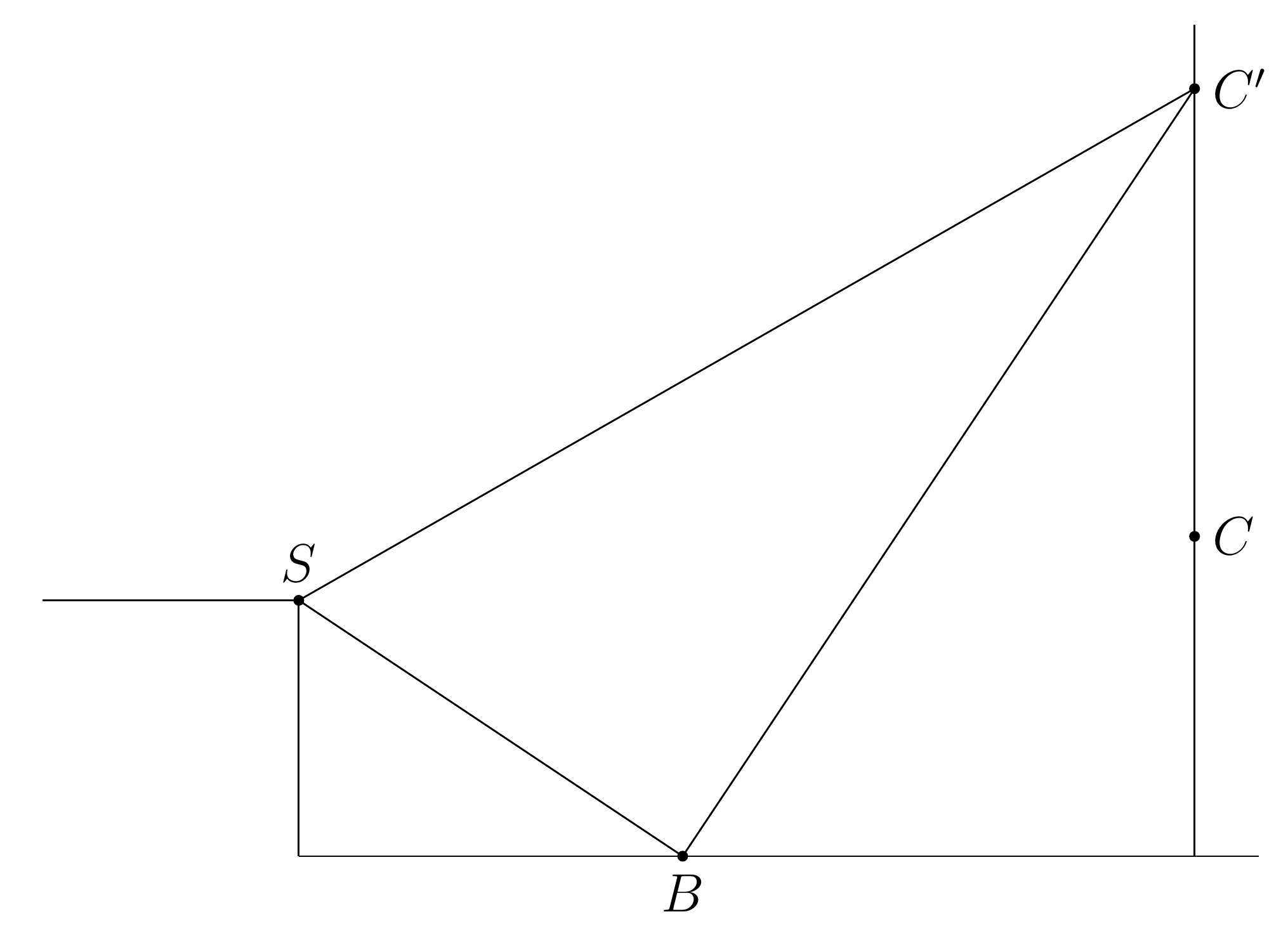
Solution 2. After going to the free fall frame, go to the frame moving with velocity . For the ball to hit the stone, its velocity in this frame must point at the stone: where . On the other hand . This means that must end up on the line . The possible ending points of are achieved by drawing a circle of radius around the ending point of . With the minimal , the circle will be tangent to , which means .
Solution 3. Without loss of generality, put at and at . The line is , so a general point is . The ratio of lengths is
Differentiating (preferably logarithmically) and setting the derivative to zero gives , i.e. and thus .
Grading (preliminary)
- The idea of switching to the free-falling frame: 0.5 pts
- Stating (explicitly or implicitly) that the stone and the ball travel in straight lines: 0.5 pts
- and : 0.2 pts (0.1 for each)
- Noticing that we need to minimise (or maximise the reciprocal): 0.3 pts
- Sine theorem (to minimise): 0.5 pts
- : 0.5 pts
- In the free falling frame is shifted upwards with respect to , , : 0.5 pts
- : 0.1 pts
- Well drawn geometrical construction (that is correct): 0.5 pts
- and : 0.2 pts (0.1 for each)
- , : 0.2 pts (0.1 for each, only if correct method)
Note. Well drawn means that straight lines are straight lines and the 90° angles look like 90° angles. Points will only be given if the construction is relevant for a correct solution.
Grading for Solution 2:
- Noticing that is on : 0.3 pts
- A valid argument that is minimal when : 0.5 pts
Grading for Solution 3:
- Correct function to maximise/minimise: 0.2 pts
- Derivative : 0.1 pts
- Performing the rest of the calculation fully correct: 0.2 pts