Problem Set
NBPhO 2025
2. Evaporation 7 pts
Piston–cylinder equilibrium with saturated vapour, and derivation of the wet-bulb temperature of sweating skin in a sauna.
Part i (2 points)
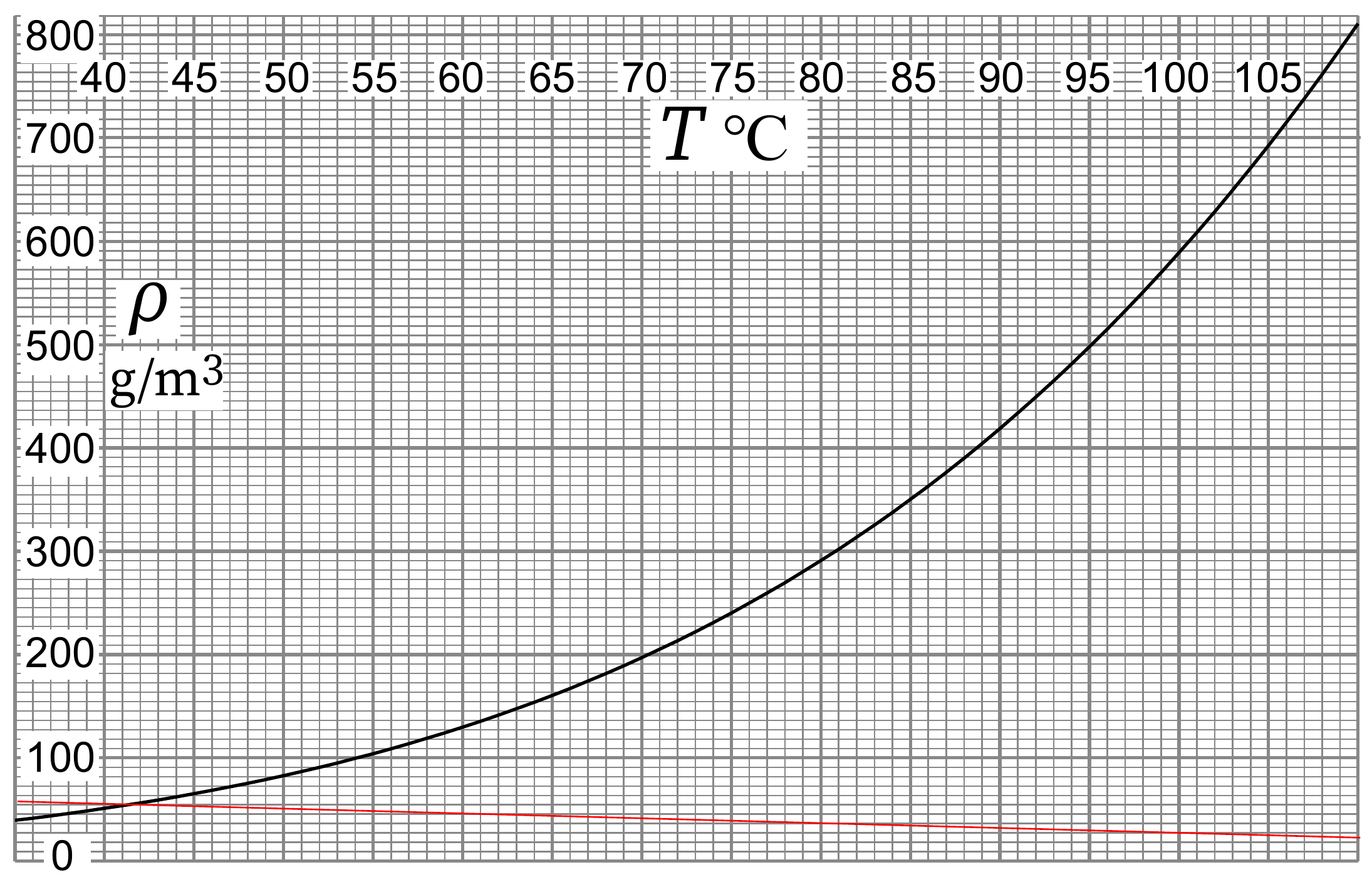
Water is in a good approximation incompressible; hence, when the piston starts moving, the growing volume must be filled by gas which can only be the water vapours. Thus, the water starts boiling: these vapours must be in equilibrium with water, hence the vapour pressure must be equal to the pressure inside the piston. We can read from the graph that at , the vapour density is ; this corresponds to the pressure . With atmospheric pressure , the force needed to pull the piston is .
Grading
- Realize that the pressure inside the cylinder equals the saturated vapour pressure of water at temperature : 0.8 pts
- Read the density from the graph, in the range : 0.2 pts
- Use the ideal gas law to find an expression for the pressure at temperature : 0.4 pts
- Correct expression for the force: : 0.4 pts
- Correct numerical answer: 0.2 pts
Part ii (2 points)
When the piston is pulled by displacement , creating new volume , the water partially evaporates to fill this volume with vapour and the remaining liquid water cools from temperature to . The mass of vapour needed to fill the new volume can be calculated using the vapour density as . For the heat balance, the energy needed for evaporation must come from the cooling of the remaining liquid water:
Here we have neglected the dependence of on temperature and the heat capacity of water vapours, because (but we have not neglected the work done by the piston, because is the enthalpy of evaporation and already includes ). Similarly, since , we can neglect in the right-hand-side and express
Grading
- Read the vapour density from the graph (): 0.2 pts
- Correct expression for mass of water vapour: 0.3 pts
- Correct expression for the latent heat (): 0.3 pts
- Correct expression for heat lost by water (): 0.3 pts
- Expression for energy conservation: 0.4 pts
- Correct expression for mass of water : 0.3 pts
- Correct numerical answer (with correct dimension): 0.2 pts
Part iii (3 points)
At thermal equilibrium, there is as much heat flux to the skin as there is heat loss due to evaporation. The former (per area) equals and the latter (per area) equals where is the mass of one molecule, which we find to be to get . Note that the minus sign comes from the fact that the particles diffuse from higher density areas to lower density areas. Now from the ideal gas law to get
Now the pressure of the water vapour is related to through , where denotes the saturation pressure of vapour. So,
where denotes the water vapour saturation pressure at the local air temperature; hence by integrating over we obtain
where the index denotes quantities evaluated at the skin surface. Also, we have used the fact that , because at the skin surface, the air is in direct contact with water (due to sweating, skin is wet), so that . Substituting we obtain
Here we evaluate from the graph and . Now we can draw this straight line onto the provided graph to find the intersection point at .
Solution 2 by Eppu Leinonen: One can also work directly with through the fact that . Then the heat flux magnitude will directly become
where is the density of the water vapour. Then with correct signs we get
from which by integrating and using we get
and the solution proceeds the same way as in Solution 1.
Grading
NB! The substitution can be done earlier so the schemes below represent only the relevant observations which can be done with already. Equivalent forms will give points (i.e. if using and instead of in the middle steps).
- Heat going away from skin (up) = heat going to skin (down) at equilibrium: 0.4 pts
- Heat flux down : 0.2 pts
- Heat flux up magnitude : 0.5 pts
- Magnitude of heat flux up is : 0.3 pts
- : 0.1 pts
- : 0.1 pts
- Deducing that the direction of the heat flow is opposite to (explicitly mentioned or with the existence of the minus sign in the equations): 0.1 pts
- : 0.1 pts
- (integrating correctly): 0.4 pts
- Or doing a change from in the derivatives, which has to be motivated properly (for Fick’s law one must state that is constant due to conservation of particles).
- : 0.1 pts
- Reading correctly (): 0.2 pts
- Graphical method: 0.8 pts
- Noticing that defines a straight line in : 0.8 pts
- Any other valid numerical method that is explained is accepted.
- Correct final result : 0.2 pts