Problem Set
NBPhO 2025
9. Hot Plate Exp 12 pts
Measure emissivity of polished aluminium, the heat transfer coefficient to air, heat capacity of a metal plate, and thermal conductance of silicone rubber pads.
Part i (3 points)
Both aluminium plates were immersed in hot water until thermal equilibrium was reached, then removed, dried with tissue paper, and measured using an infrared thermometer. The plates have identical thermal properties except for their surface coating, so they should have reached the same actual temperature in the hot water bath. Experimental measurements:
| (°C) | (°C) | (°C) |
|---|---|---|
| 26.2 | 70.9 | 22.9 |
| 26.0 | 70.7 | 22.9 |
| 25.4 | 70.2 | 22.9 |
The infrared thermometer measures temperature based on thermal radiation and is calibrated for emissivity (in reality , but this difference is not significant). The radiation power can be linearized: . Objects with radiate , but they also reflect/scatter the radiation from the environment. If the room is at thermal equilibrium at temperature , the room is filled with photons at equilibrium with walls at temperature . As it follows from the second law of thermodynamics, the reflectance must be , so it reflects/scatters power equal to . The total power departing from it is . The IR thermometer equates this to , hence the reading is a weighted average:
Since the black plate has , its reading directly gives the actual temperature of both plates. Rearranging to solve for emissivity:
Calculating for each measurement:
Taking the average: .
The emissivity of the polished aluminium plate is .
Grading (preliminary)
- The idea of heating the two plates together in water: 0.4 pts
- Measuring the radiance of the plates properly (plates are properly dried and measurements are done in a timely manner): 0.4 pts
- Making at least three measurements of the black plate, the polished plate and the surrounding environment (0.2 pts for each set of 3, totalling): 0.6 pts
- Understanding that the IR temperature reading of the polished plate is affected not only by the plate itself, but also by the reflected radiation of the environment (, not just ): 0.3 pts
- Deriving a correct formula for emissivity, expressed in terms of the three measured temperatures: 0.7 pts
- Calculated value of emissivity in the range from 0.03 to 0.12: 0.6 pts (for values from 0.02 to 0.2: 0.4 pts; for values from 0.01 to 0.3: 0.2 pts)
Part ii (3 points)
Solution 1. Here the main idea is to heat the plate using the resistor. Once thermal equilibrium is reached with the plate’s temperature , the heating power equals the power dissipated to the environment, (with denoting the room temperature), hence
The main difficulty is that the characteristic thermalization time is long (around 7 minutes), so for a more or less precise measurement, one should wait around half an hour.
Solution 2. The black aluminium plate was placed on the foam plastic with the resistor beneath it, providing continuous heating. Temperature readings were recorded at one-minute intervals:
| (min) | 0 | 1 | 2 | 3 | 4 | 5 | 6 |
|---|---|---|---|---|---|---|---|
| (°C) | 28.0 | 30.8 | 33.2 | 35.2 | 37.3 | 39.0 | 40.3 |
For heating with constant power, the temperature evolution follows , where is the final equilibrium temperature, is a constant depending on the initial temperature, and is the inverse of the characteristic time constant. To determine , we examine successive temperature increments with , which should decrease exponentially:
| (min) | (°C) | |
|---|---|---|
| 0 | 2.80 | 1.0296 |
| 1 | 2.40 | 0.8755 |
| 2 | 2.00 | 0.6931 |
| 3 | 2.10 | 0.7419 |
| 4 | 1.70 | 0.5306 |
| 5 | 1.30 | 0.2624 |
Linear regression of versus yields with , giving (time constant ).
![Figure: Logarithm of the per-minute temperature increment \ln[T(t+\tau) - T(t)] plotted against time t (blue dots) for the heating run with \tau = 1\,\text{min}. The red line is the linear fit \ln\Delta T = 1.0333 - 0.1378\,t (R^2 = 0.9209); its slope gives the cooling rate \gamma = 0.1378\,\text{min}^{-1}, equivalent to a time constant 1/\gamma \approx 7.3\,\text{min}.](/figures/nbpho-2025/sol09-fig1.png)
We then plot versus to find as the intercept when . Linear regression yields :
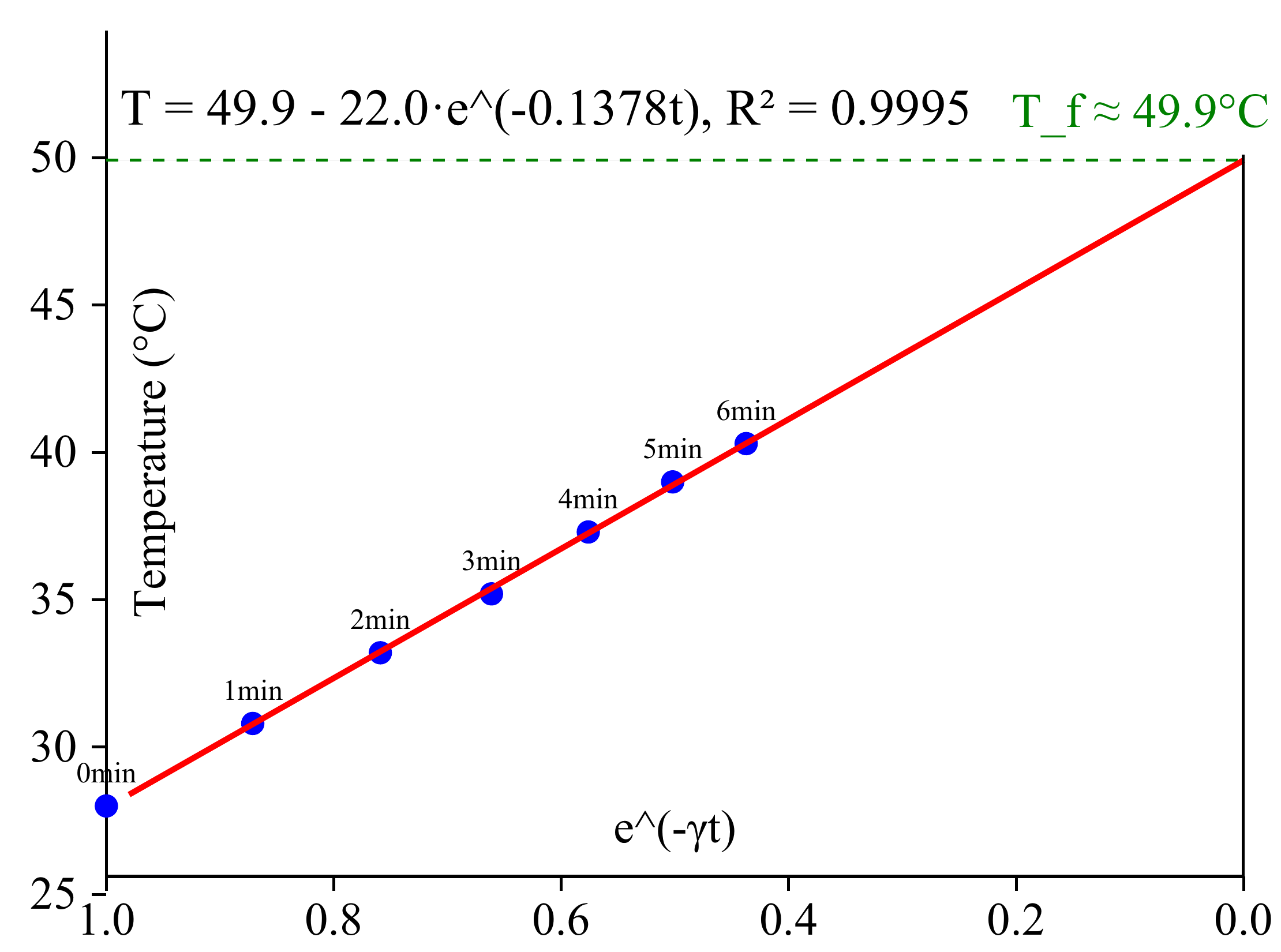
At thermal equilibrium the power dissipated equals the power supplied:
Using , , and :
Grading for Solution 1 (preliminary)
- The idea of using resistive heating and waiting for thermalization: 0.5 pts
- For waiting long enough, up to 0.8 pts: for each five minutes missing from more than 30 minutes, subtract 0.2 pts
- The voltage is maximized to have maximal (needed to reduce the relative error of ): 0.4 pts (the maximal allowed voltage of 15 V gives maximal points; each missing volt subtracts 0.1 pts)
- Measuring the temperature and obtaining a value that is reasonable for the given voltage (difference not bigger than 1 °C): 0.6 pts
- Deriving a correct formula for : 0.5 pts
- Evaluating correctly: 0.2 pts (any mistake, either with units or arithmetic, leads to no points)
Grading for Solution 2 (preliminary)
- Coming up with the idea of analysing exponential decay of temperature change with a graph and deriving the heat transfer coefficient from that: 0.5 pts
- Correct equation : 0.3 pts
- Plotting the data to a graph to determine and to confirm the validity of collected data: 0.3 pts
- At least 5 datapoints used: 0.1 pts
- Measure for at least 5 minutes: 0.1 pts
- Calculating the slope and retrieving from it: 0.2 pts
- Finding the maximal temperature for used voltage, using plot of vs : 0.5 pts
- Evaluating without errors: 0.5 pts
- Getting heat transfer coefficient close to expected value: 0.5 pts
Part iii (2 points)
Solution 1. To determine the heat capacity, we use the heating curve from Part ii. During heating, the energy balance is
where , , and is the heat capacity. Using the exponential model :
Substituting:
Using , , , , , , the input power is .
| (min) | (°C) | (W) | (W) | (K/min) | (J/K) |
|---|---|---|---|---|---|
| 0 | 28.0 | 0.193 | 0.830 | 3.018 | 16.5 |
| 1 | 30.8 | 0.299 | 0.724 | 2.629 | 16.5 |
| 2 | 33.2 | 0.389 | 0.633 | 2.291 | 16.6 |
| 3 | 35.2 | 0.465 | 0.558 | 1.996 | 16.7 |
| 4 | 37.3 | 0.544 | 0.478 | 1.739 | 16.5 |
| 5 | 39.0 | 0.609 | 0.414 | 1.515 | 16.4 |
| 6 | 40.3 | 0.658 | 0.365 | 1.320 | 16.6 |
The heat capacity values are remarkably consistent, validating our model. Taking the average yields .
For reference, , so the plate mass is , consistent with a plate with thickness approximately 2 mm.
Solution 2. A better approach is to make an additional series of measurements to obtain a cooling temperature curve, excluding the contribution of the resistor’s thermal capacity. We heat the plate (easiest by immersing in hot water) and measure as it cools. The energy balance gives
The decay rate is found from the slope of plotted against .
Grading (preliminary)
- The idea of using the dependence, either for cooling or heating with the resistor: 0.2 pts
- Measuring and tabulating at least 6 data points: 0.3 pts (subtract 0.1 pts for each missing)
- Data points cover at least 6 minutes: 0.3 pts (subtract 0.1 pts for each missing minute)
- The idea of using log-linear plot for data linearization: 0.2 pts
- Correct data plotting: 0.2 pts
- Finding the slope of a fit line: 0.2 pts
- The idea of substituting time derivative with multiplication by : 0.2 pts (calculating derivative by finite difference ratio is significantly less accurate)
- Deriving a correct formula for : 0.2 pts
- Obtaining a reasonable numerical value for , from 13 to 20 J/K: 0.2 pts (else from 10 to 25 J/K: 0.1 pts)
Part iv (4 points)
Cooling experiments were conducted with the aluminium plate covered by different numbers of silicone rubber layers. The plate was heated in water and allowed to cool, with temperature recorded as a function of time.
| (s) | 0 | 60 | 120 | 180 | 240 | 300 |
|---|---|---|---|---|---|---|
| (°C) | 65.2 | 60.2 | 55.5 | 51.3 | 47.6 | 44.6 |
| (°C) | * | 35.3 | 34.0 | 32.9 | 31.9 | 30.8 |
| (°C) | 45.4 | 43.1 | 41.6 | 40.0 | 38.9 | 37.3 |
*The data point at for 2 layers is excluded as it did not represent complete thermal equilibrium across the silicone layers.
For a cooling process with constant ambient temperature , the temperature follows exponential decay . The time constant is related to the thermal resistance and heat capacity by
Taking the natural logarithm of the temperature difference from ambient yields .
Using linear regression on the logarithmic cooling curves:
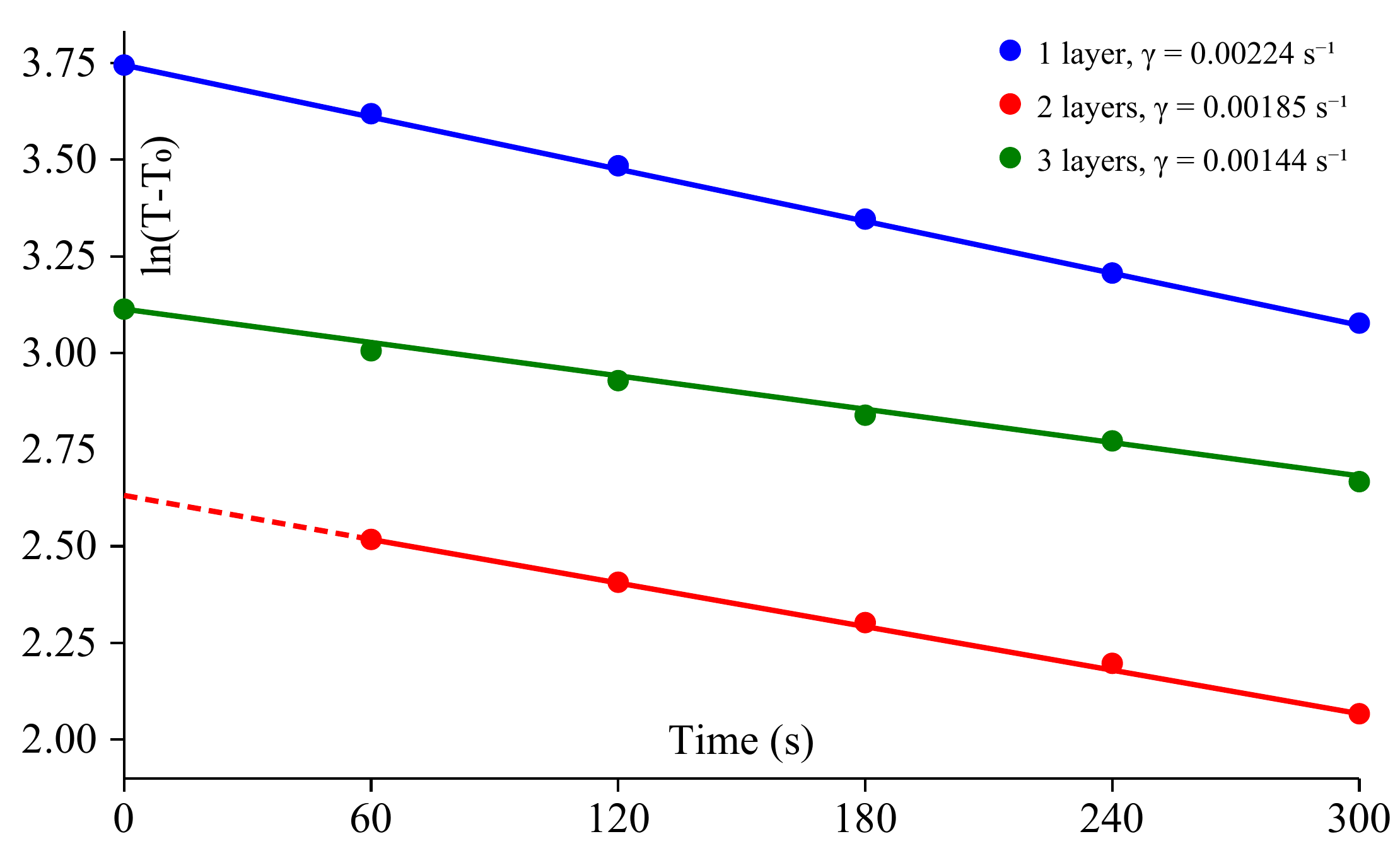
Using , the total thermal resistance for each case is:
Each additional layer adds a resistance , where is the layer thickness, is the thermal conductivity, and is the area. The incremental resistances are:
Taking the average:
With and :
Grading (preliminary)
- The idea of letting the plate cool down while covering it with a different number of silicon sheets and measuring the dependencies: 0.3 pts
- For the quantity of recorded data: within each data series, at least 6 data points: 0.3 pts (subtract 0.1 for each missing); within up to three different data series — in total up to pts
- Data points in each data series cover at least 6 minutes: 0.2 pts (0.1 pts if less than 6 but more than 4 minutes) — in total up to 0.6 pts
- The idea of using log-linear plot for data linearization: 0.2 pts
- Correctly plotting the data: 0.1 pts each, up to 0.3 pts
- Calculating for each of the series, 0.1 pts for each, in total up to 0.3 pts
- Correctly expressing the heat conductivity in terms of a difference of the values: 0.7 pts
- Finding conductivity on the basis of all the values (either by pair-wise calculation, or plotting and finding the fit line slope): 0.4 pts (divide by two if only one pair of values was used)
- Obtained value of within a reasonable range, i.e. from 0.05 to 0.1 W m K: 0.3 pts (else if from 0.04 to 0.12: 0.2 pts; else from 0.02 to 0.14: 0.1 pts)