Problem Set
NBPhO 2025
1. Flying Dumbbell 10 pts
Dynamics of a steel dumbbell in zero gravity — longitudinal oscillations and wall collisions at various angles of incidence.
Part i (2 points)
Free oscillations of the dumbbell take place around the centre of mass, i.e. the centre of the rod. Therefore, we need the stiffness of a half of the rod. This stiffness is expressed as . We also need the mass of the ball . The oscillation angular frequency , hence the period
Grading
- Explaining that oscillation is symmetric around centre of the rod (invoking Newton’s third law suffices): 0.5 pts
- Expressing stiffness of half-rod: 0.5 pts
- Minor mistake made in stiffness expression: −0.2 pts
- Mass of the ball : 0.2 pts
- Realising that the system can be treated as a spring: 0.3 pts
- Oscillation period : 0.3 pts
- Final answer: 0.2 pts
Part ii (2 points)
The easiest way to estimate is to notice that a compressed ball is essentially a compression wave in steel, so the period is on the order of a wave with wavelength . Knowing that the sound speed , we obtain
Alternatively, one can approximate the ball as a spring of stiffness and mass , and obtain a similar result with .
Grading — Solution 1
- Realise compressed ball is essentially a compression wave: 0.5 pts
- Formula for speed of sound: 0.5 pts
- Relation between time, radius and speed: 0.5 pts
- Final answer: 0.5 pts
Grading — Solution 2
- Realise the ball can be thought of as a spring: 0.5 pts
- Estimate spring constant: 0.5 pts
- Relation between spring constant and time or frequency: 0.5 pts
- Final answer: 0.5 pts
Part iii (2 points)
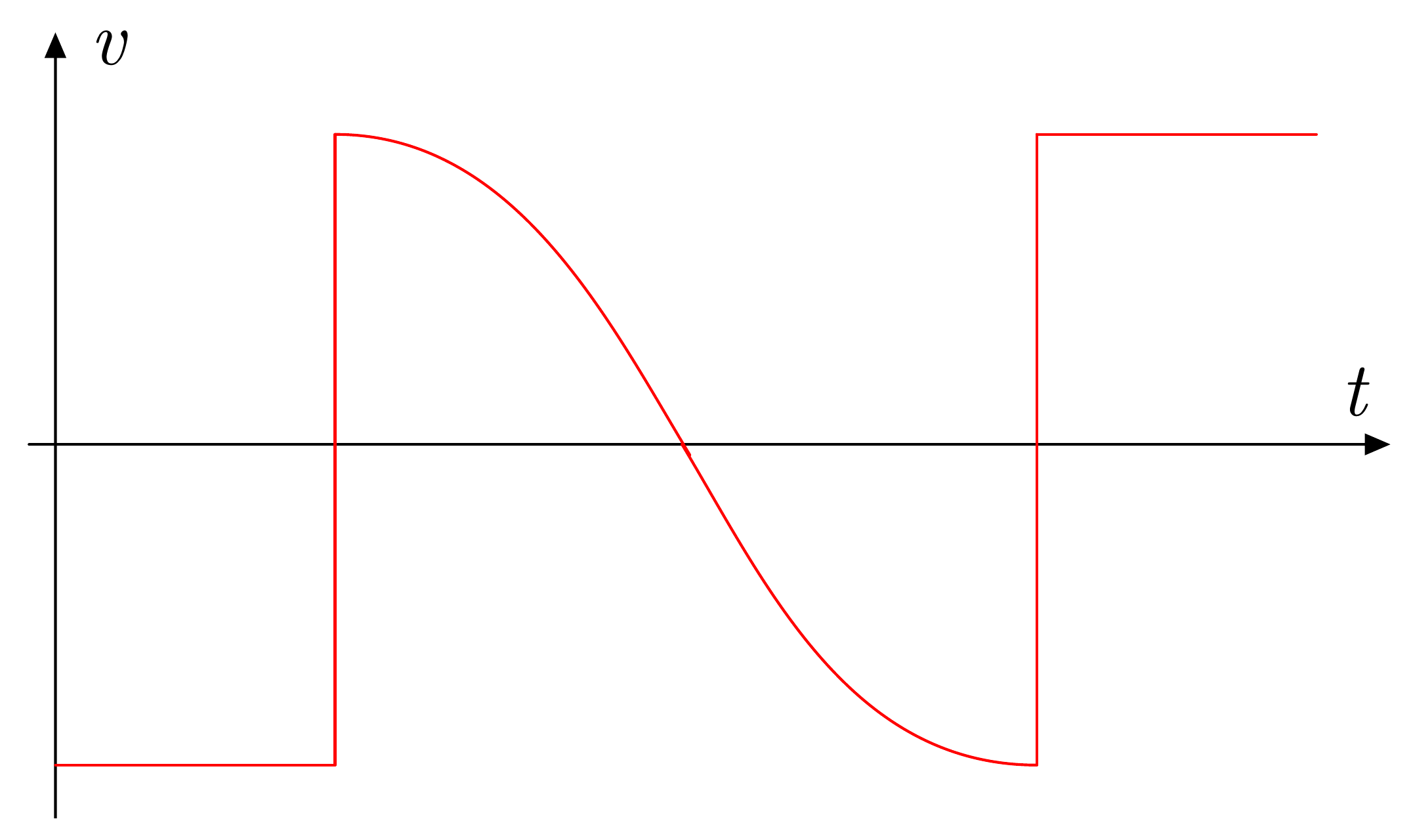
When the dumbbell with axis perpendicular to the wall approaches with velocity , the front ball impacts the wall first. Since the impact time () is much shorter than the oscillation period (), the front ball’s velocity changes almost instantaneously from to , while the rear ball continues with velocity . Since the balls have equal masses, the centre of mass remains stationary. The dumbbell then oscillates about this stationary centre of mass, with the front ball’s velocity following a half-period sinusoidal oscillation, changing from to over a time interval of . When the velocity reaches , the front ball impacts the wall again, and its velocity changes instantaneously from to . After this second impact, both balls move away from the wall with the same velocity , so the dumbbell as a whole departs with velocity .
Grading
- 2 hits: 0.4 pts
- Velocity of front ball flips almost instantaneously: 0.4 pts
- Centre of mass stays at rest: 0.4 pts
- Sinusoidal movement of front ball: 0.4 pts
- Constant velocity of front ball after second hit: 0.4 pts
Part iv (2 points)
During the impact, the front ball velocity becomes opposite, so the centre of mass stops (as the rear ball moves still with its old speed). After the collision, the front ball obtains a component along its axis, and perpendicular to it. The former initiates oscillations of period , and the latter — a rotation at angular speed
The ball will hit the wall twice if the rotation is slow, and only once if the rotation is fast enough. By time , the rotation angle is , and the distance of the farthest point of the ball from the rotation centre is , where the oscillation amplitude is obtained from energy conservation:
So, the distance from the wall of the closest point of the ball is
If this expression becomes negative, there will be a second collision. So, the cross-over value is such that the expression becomes never negative, hence
hence
Grading
- Realise it behaves as in previous question (balls at velocity and , CM at rest), but it now also rotates and oscillates around centre of mass: 0.5 pts
- Expression for the angular speed of rotation: 0.3 pts
- Expression of the amplitude of oscillations: 0.2 pts
- Realise the difference in interaction is whether the first ball bounces once or twice: 0.2 pts
- Formula for the distance of the front ball to the wall over time: 0.3 pts
- Realise that if the distance is over 0 for all the first ball does not hit the wall twice: 0.2 pts
- Finding the critical angle given this condition: 0.3 pts
Part v (2 points)
Using the results of the previous task, the angular speed after the initial collision is . The dumbbell rotates around its centre of mass; longitudinal oscillations decay by the time of the second collision. It rotates until the other ball hits the wall. At the moment of the second collision, the velocity of the ball is , and its projection to the surface normal of the wall is . During the second collision, that component reverses sign, and as a result, both balls now have -directional velocity component . Hence, this is also the speed of the centre of mass — the speed with which the dumbbell departs from the wall.
Grading
- Realise that the dumbbell rotates around its centre of mass (after first collision): 0.2 pts
- Realise that the longitudinal oscillations have decayed by the time of the second collision: 0.4 pts
- Expression for velocity of ball : 0.5 pts
- Expression for the component of velocity of ball in direction of surface normal : 0.5 pts
- Realise the component of velocity of second ball in direction of surface normal is also : 0.2 pts
- Realise the speed of the centre of mass : 0.2 pts