Electronics with Kids Electronics with Kids
A hands-on electronics series for a young child and a science-fluent parent —
five core projects, plus a sixth, and a from-first-principles explainer for
the grown-up.
Created by Mihkel Kree using Claude. The project plan, all lesson texts, and
the explainer chapters were written entirely by Claude (Opus 4.8). Mihkel simply built
the circuit, took the photo, and put the site together.
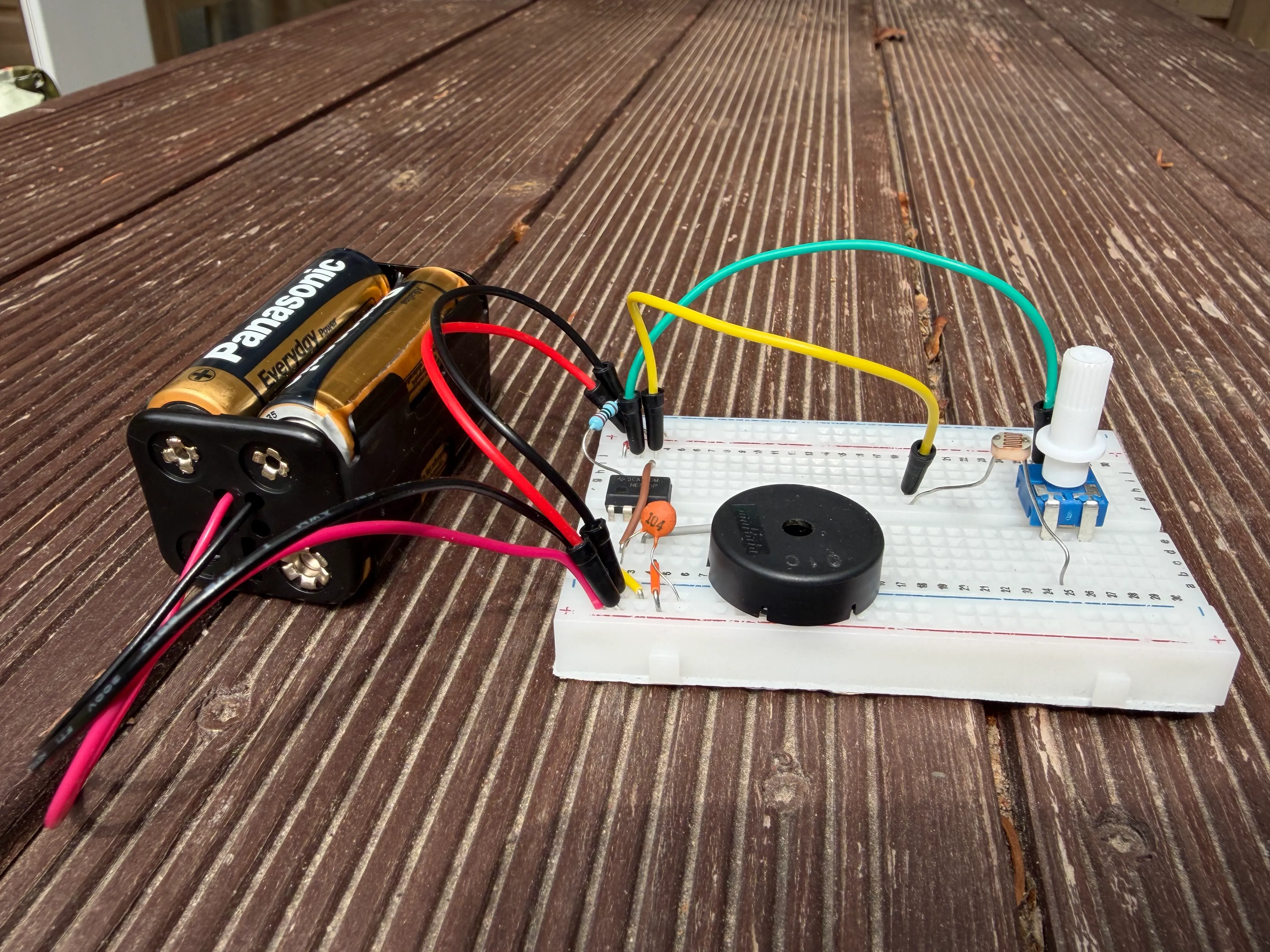
The breadboard I built following Project 6 involving
a 555 timer driving a buzzer, a capacitor, a photosensitive resistor and a
potentiometer knob to bend the pitch dicated by the RC timescale.
Photo by Mihkel Kree Electronics with a 6-year-old — Read Me First Safety, parts list, and the learning arc for a hands-on electronics series (five core projects plus an optional sixth) for a young child, led by a science-fluent parent. Project 1 — Make the Light Come On A child's first circuit: an LED, a resistor, and a battery wired into a loop with alligator clips. Teaches that current flows only when the circuit is complete. ●○○○○ 15–20 min Project 2 — Press-to-Buzz Doorbell Add a buzzer and a pushbutton to the basic loop to build a working doorbell. Teaches that a switch is a deliberate, controllable gap in the circuit, and introduces series vs. parallel. ●○○○○ 15–20 min Project 3 — The Spinning Motor Drive a small DC motor straight from the battery and watch a pinwheel spin. Swapping the wires reverses the spin. Teaches that electricity does work and that it has a direction. ●●○○○ 15–20 min Project 4 — The Light That Fades by Itself Charge a large capacitor, disconnect the battery, and watch an LED fade out slowly instead of snapping off. Teaches energy storage and, for the parent, the RC time constant. ●●●○○ 20–25 min Project 5 — Steady-Hand Buzz-Wire Game The capstone: bend a wiggly wire track and a loop handle so that touching them completes the circuit and sets off a buzzer and light. Consolidates loop, switch, and buzzer into a toy the child builds and plays. ●●●○○ 25–30 min Project 6 — Make Your Own Sound (Passive Buzzer Tone Generator) A passive buzzer only clicks on plain DC — it needs a signal that switches on and off thousands of times a second. Build a 555 oscillator to drive it, and a knob to change the pitch. Makes the RC time constant audible. ●●●●○ 25–30 min Project 7 — The Invisible Eye (Beam-Break Treasure Alarm) Meet the optointerrupter: an invisible light beam and an electronic eye in one small package. First a finger in the slot sets off a buzzer; then a 555 one-shot turns it into a real treasure-trap alarm that screams when the loot is moved. ●●●○○ 25–30 min Project 8 — Photo Finish (Who Really Won the Race?) Two light gates across two lanes and a latch that remembers which beam broke first — a fair, incorruptible race judge. The series' first memory circuit, with an optional Arduino upgrade that prints the winning margin in milliseconds. ●●●●● 40–60 min (or two sittings: gates, then latch) Project 9 — The Speedometer You Can Hear A slotted cardboard disc on the Project 3 motor chops the optointerrupter's beam into clicks; spin fast enough and the clicks blur into a tone whose pitch is the speed. Measure the RPM with a phone tuner app — or an Arduino tachometer. ●●●●○ 30 min Project 10 — Punched-Card Music Box A paper strip with punched holes slides through the optointerrupter and gates the Project 6 tone generator: hole = note, cardboard = silence. The child programs rhythms with a hole punch — information stored as holes, exactly like player pianos and early computers. ●●●●○ 30–40 min (plus endless composing) Project 11 — The Marble Counting Machine Marbles rolling down a track flick a little flag through the optointerrupter, and a CD4017 decade counter steps a lit LED along a row of ten — a machine that counts with no brain at all. Optional Arduino digit display, and a second 4017 to count to 99. ●●●●○ 30–40 min Project 12 — The Light Theremin Swap Project 6's pitch knob for a light-dependent resistor and the oscillator plays whatever your hand does: shadows glide the pitch down, a flashlight sends it shrieking up. One new part, one big idea — a resistor that feels light. ●●○○○ 15–20 min Project 13 — You Are a Wire (The Touch Switch) Two transistors stacked into a Darlington pair amplify the whisper of current that flows through a fingertip into enough to light an LED. Touch two wires and you're part of the circuit — then hold hands and the whole family is. ●●○○○ 15–20 min Project 14 — The Song That Rides on a Light Beam The Project 6 tone generator blinks an LED thousands of times a second — too fast to see, but a phototransistor across the room hears it perfectly. Music over a light beam: block it to mute, bounce it off a mirror, and then listen to the secret songs of every lamp in the house. ●●●○○ 25–30 min Project 15 — The Electromagnet Crane Wind wire around a big nail, press a button, and it becomes a magnet — release, and the paperclips rain back down. A magnet with an off switch, plus Ørsted's compass trick. Opens the electromagnetism arc: electricity and magnetism are one thing. ●●○○○ 25–30 min Project 16 — The Switch Nobody Touches (Reed Switch Door Alarm) A tiny glass capsule clicks shut whenever a magnet comes near — through cardboard, through the tabletop, through your hand. First a magic trick, then the real thing: the magnet-and-reed door alarm that guards millions of actual houses. ●●○○○ 20–25 min Project 17 — The Switch That Presses Itself (The Relay) Pop the lid off a relay and there it is: Project 15's electromagnet and Project 16's springy switch in one box. A tiny button-circuit clicks it, and a completely separate motor-circuit obeys — one circuit commanding another, the building block computers were first made of. ●●●○○ 25–30 min Project 18 — The Machine With Hiccups (Self-Interrupting Relay) Wire the relay so its own switch cuts its own power and it can't decide — on, off, on, off, hundreds of times a second: BZZZZ. The child has built the classic electric bell mechanism, the 555's mechanical grandfather, and can watch every beat of it with the lid off. ●●●○○ 20–25 min Going deeper — for the parent NE555 Explainer — How a Timer Chip Becomes an Oscillator Explainer · Bachelor-level physics A from-first-principles explainer of the NE555 timer IC for a physicist with no prior electronics/IC training: the internal architecture (divider + two comparators + SR latch + discharge transistor), the three operating modes, and a full derivation of the astable frequency formula f ≈ 1.44/((R1+2R2)C) as an RC relaxation oscillator. Companion to Project 6. Wiring Explainer — From Schematic to Breadboard Explainer · Hands-on — no prerequisites A hands-on bridge for someone who understands the circuit but has never physically built one: how a breadboard is wired inside, how to find pin 1 on a DIP chip, how to identify resistors / ceramic caps / the pot / the buzzer, and a column-by-column build of the Project 6 NE555 oscillator with a debugging checklist. Companion to Project 6. Optoelectronics Explainer — LEDs Backwards: How Silicon Sees Light Explainer · Bachelor-level physics A from-first-principles explainer of the optointerrupter for a physicist: photon absorption across a bandgap, photodiode vs phototransistor vs LDR (junction drift vs bulk photoconductivity, and the speed hierarchy that follows), why the emitter is a 940 nm GaAs LED, the pull-up resistor as a load line, and the two wiring polarities used in Projects 7–11.